We are glad to announce that our partner, Eezee-It has been promoted to Gold Partner status. Eezee-It is a Belgian company specialised in enterprise management solutions based on OpenERP.
Partner since 2010, Eezee-It helps small and medium companies from multi-sectors to integrate and improve their business process with OpenERP.
Eezee-It has recently developed an OpenERP v5, v6 and v7 mobile client for iOS and is working on a new multi-platform mobile client (iOs and Android) with full reading and writing features from and to OpenERP.
"A true professional, dynamic and customer minded Team. The perfect recipe for a successful OpenERP Integration”, said Ludovic Pimpurniaux, OpenERP Partner Account Manager.
The company, located in the Axis Parc at Louvain-La-Neuve, also proposes the Eezee-Box product, an OpenERP hosting solution delivered as a cloud computing platform.
Discover more about Eezee-IT and how you can contact them here: http://eezee-it.be/
We are glad to announce that SCIP SITA and Elico Corp Shanghai have signed a cooperation agreement to implement OpenERP. SCIP SITA is the largest and most sophisticated hazardous waste incinerators in mainland China.
OpenERP will be used to manage all operations related to plant management and administration. The project, combining resources from both companies, has started in April 2013 for an expected duration of 2 years.
The first phase will focus on core business management processes such as: Waste and Customer contract management, Sales, Warehousing, Purchasing, HR, Accounting and CMMS integration.
A second phase will complete this scope with manufacturing processes and the integration with laboratory management and gate attendance.
SCIP SITA Waste Services is a subsidiary of Suez Environment that operates the
largest and most sophisticated hazardous waste incinerators (2 lines) in mainland China, with an a
nnual treatment capacity of 60,000 tons per year. More information.
Elico Corp is OpenERP Silver Partner and Premium Certified Training Center in China. The company
operates two offices in Shanghai and ShenZhen and covers the following area: JiangSu, ZheJiang, GuangDong, Macau and Hong-Kong. More information.
We are excited to announce that our long-standing Belgian partner, BHC IT Services, has been promoted to Gold Partner status. The Gold partnership level is awarded to companies that have demonstrated a significant and continued investment in OpenERP implementation, integration and support services; who have successfully managed projects for a wide variety of companies; and who have developed strategic relationships in alignment with OpenERP's goals.
BHC IT Services have more than 15 years of experience in development and integration of management software, from small and medium business to corporate companies of several thousands users. They're an early adopter of several Open-Source solutions, and are working with Open-Source ERP since 2005. BHC became an official OpenERP partner in 2008 and have successfully managed a lot of different OpenERP customer projects since then.
BHC is also contributing a lot to the community by developping extra OpenERP modules, their most known developments are the Android suite of Business Applications for OpenERP and the realtime XML integration module for IngramMicro.
Based in the Wallonia Digital Innovation Valley (Mons, Belgium), BHC is delivering its services both to the local and international market.
Learn more: http://www.bhc.be/en

The Open Days are dedicated to all our community, partners, clients and end-users. It's a time when we come together and showcase the new features, future version and achievements.
This year, the Open Days are preceded by 2 days of training sessions for experts! We propose 4 different training sessions, 2 days each.
Training Sessions: 1 - 2 July 2013
These training sessions are dedicated to advanced OpenERP technical and functional users. An additional session is reserved to sales. Check here a preview of the functional training. More information.
Subscribe here (until May 6th to benefit of the Early bird price)
Open Days: 3 - 5 July 2013
Discover the future version of OpenERP, learn to implement best community modules and get feedback from successful partners. Around 1500 people will attend to share knowledge, experience an best practices. More information.
In January 2013, we defined the 'QuickStart' methodology that allows deploying small to medium companies in production in just a few days. Read more here and see what participants had to say:
1) What is your feeling after three days of training?
The training is interactive, it's great! The trainer is very flexible and is not just following the content word by word. He understands our needs and looks at each case individually. He plays a real consultancy role. This privileged contact is a nice surprise.
2) Does this training meet your expectations?
Training goes far beyond the expectations and further in details. We see the real product ‘live’ with demos and beyond the field of CRM. Training is tailored entirely to our operating environment.
3) Are you ready to use OpenERP?
Absolutely! I acquired the necessary skills to configure a database tailored for our needs. In addition, I am able to import the list of students in the system. So, we can do the first tests soon with our teachers.
1) What do you think of the commercial approach related to the Get On Board sessions?
The approach is excellent. The OpenERP salesperson understood my needs very quickly and I was directly advised to participate in this session. Regarding the process, it's simple, I didn’t have to do anything!
2) Does this training meet your expectations??
Yes, I can now manage my business opportunities, my orders, invoices and delivery notes. Before, we generated invoices in Excel. We really needed a more integrated solution at the level of the overall flow of sale. Version 6 of OpenERP seemed a little complicated to deal with but with version 7 it is very different. It starts much easier, it's very intuitive!
3) What do you think of this learning format?
With three people, training was highly interactive and we had a lot of back and forth. If there were more people, it would have been difficult to have such interaction. Overall, I am very satisfied. Regarding the comprehension part, I am 100% operational. Now I just need to encode some information in my database and to implement the automatic startup of the server. I would never have expected such an outcome after only three days!
1) How did you find our training Get On Board?
We attended the presentation of OpenERP 7 in Brussels and when we saw all the features we directly said: "OpenERP is for us! ". The salesperson with who we were in contact with, told us immediately after the demonstration about this new type of training. We signed up right away!
2) What do you get from this training?
I am very happy with the training. I did not think we would see so much in so little time. Watching the program at first, I thought that some of my questions about the features would remain unanswered. It did not happen! I particularly enjoyed the interaction with other participants and the trainer flexibility, he always takes time to answer our questions, even if it must go beyond schedules.
3) Does this training meet your expectations?
Training has exceeded expectations. Given the implementation time of our previous software, I've never imagined being able to leave the training with a database ready for use. Initially, I imagined a training course much more commercial, rather like a demonstration of OpenERP. This was not the case at all! During each stage of learning, each participant was able to examine his case with the help of the trainer. I can say that the training has overexceeded my expectations.
4) Do you think that you hold an operational database thanks to these three days of training?
For my personal company and for the nurse planning of my wife, yes, completely! All that I suggested to my wife before was too complicated. She will love OpenERP!
Regarding Neolabo, we can already use the system point of sale for our store. Regarding the CRM, I would say we are operating at 80%. This is quite normal because we have 20 years of programming behind the system we use now, we knew that we wouldn’t reach this level in three days. It's already amazing to be at 80%!
5) Do you have a clear idea of what needs to be set or adapt for a fully operational system ?
Yes, there will be some adjustments to make, but that development will be done by an OpenEPR partner. With this training, I have a very good idea of what is operational, what is missing and what needs to be done. If I had not followed the training, I would not dispose of the necessary knowledge of OpenERP standards to establish a list of adjustments.
Are you interested in starting your business with OpenERP, but afraid it will take too long? Do you want to see how it works in production with your own company in just a matter of days?
Then, you'll be happy to know that in January 2013, we have defined the 'QuickStart' methodology that allows deploying small to medium companies in production in just a few days. We have set-up this offer to meet any standard needs.
How does it work?
What does Quickstart cover?
1. The OpenERP Enterprise Contract (1 year coverage): unlimited bugfix, security alerts, migration
2. The “Get on Board” Hands-on Training (choice between our core modules)
3. On-site consulting (minimum 2 days)
The QuickStart offer simply enables any SME to start using OpenERP in just a few days. Since we launched this approach, we already deployed 50 customers in production. Check out some of the testimonials!
Currently, this offer is available for Belgium, but soon will make it available for more countries. So, if you are interested, sing up for the next event of Get on board Service - May 06 - 08
Read more and Start now!
We have integrated your internal communication, emails and chat with your colleagues, suppliers and clients. Now discover how you can use the OpenERP chat to communicate with your potential clients.
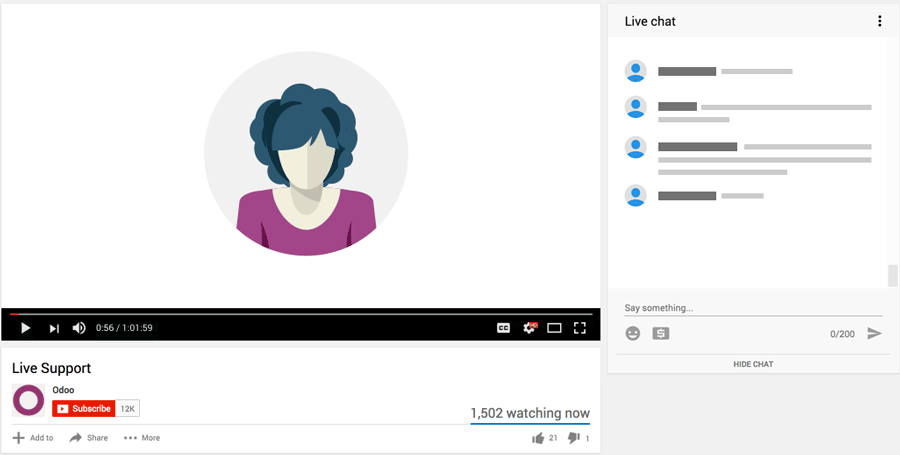
The new feature that we have in development is live chat support that can be directly linked to your website. This means that in just a few steps you can activate a live chat support on your website to talk to users who need assistance.
There are two ways to activate the live chat support. This window shows you the simple procedure you have to follow in order to configure the live chat on your website. One way is by just copying a code snippet and the second way is using the URL that OpenERP provides inside the features.

If you choose to go for the second option (copy the given url and email it to the customer) you will access a live chat website powered by OpenERP.

As mentioned in a previous blog post about our live IM, you will be able to chat with other employees or customers.

It's very easy to search for online users and check their availability.

As in the case of the live IM (Instant Messaging), the live chat support will be available for our Saas clients in version 7 and for the rest of the users in version 8.
If you want to use a professional ERP in an educational environment at no charge, then OpenERP is the right tool for you. OpenERP has decided to empower teachers and professors worldwide with its powerful ERP for free for educational purposes!
Using OpenERP is ideal for classes like business management, accounting, sales, human resources, etc. So, now schools interested in providing courses on OpenERP will benefit from a program that help them:
teach and work with the present technology and business management practices around ERP;
study real cases of implementation of an ERP in enterprises;
prepare students for the labor market by emphasizing the importance of ERP on trades and skills of IT Management
All this is done on our online platform, where teachers can manage an unlimited number of different users /students and databases. On top of that, teachers are equipped with a complete official training material of OpenERP (exercises, solutions, OpenERP documentation...)
There are just a few conditions, that shouldn't be difficult to meet, like school/university name, grade of the students, name of the course you plan to have on OpenERP and a brief description of the course and objectives. Our goal is to create a community of people sharing their knowledge on OpenERP.
The access to OpenERP online will be given with a special promo code. After 6 months, all the databases created with your promo code will be all deleted.
If you are interested, just drop an email to Charline - education(at)openerp.com.
We are very excited about the new live IM feature it's being developed and it will be soon be merged in 'trunk' branch of OpenERP. This feature will enhance user communication with their colleagues and any user, like customers and suppliers. The condition is to have an OpenERP account and be logged in to the same OpenERP database.
The new OpenERP help section is live! With the launch of OpenERP 7 we also wanted to improve the Q&A system. So, we gave up the old OpenERP forum for a better and more efficient platform with a better quality content. We do not plan to import the old forum in the new OpenERP helpsection, just keep a read-only version as an archive.
The new Q&A system is meant to build a structured and reliable OpenERP knowledge base, with no spam, focused on questions, not discussions and meritocracy based. To be able to keep a high quality content, some topics will be forbidden on this Q&A platform, like informal discussions, non-English questions, etc.

Only practical questions based on actual problems are allowed. To make this happen, the system will be auto-moderated by the users. Users get rights to perform actions (edit post, retag, delete) according to their reputation (votes on their contributions).
It's fully integrated with OpenERP Accounts (the OpenERP single sign-on service) which means OpenERP users can sign in/up in only one click.
We have prepared a space for you to have discussions, including in different languages. So, we have launched a few open Google+ Communities on +OpenERP for everything that does not fit in the Q&A guidelines. You can already subscribe for English, French, Spanish, German and Chinese. If you want to add a new language, just email ngh(at)openerp.com.
The new section is available on http://help.openerp.com
To know more about what you are encouraged to ask or contribute on the OpenERP help section, please read the FAQ http://help.openerp.com/faq/
The core contributors of the OpenERP Magento connector (Camptocamp and Akretion) have decided to completely redesign the connector and make it more flexible and adapt it to the new version 7.0.
In order to be able to finance this development, Camptocamp and Akretion have launched an extensive background research at an international level. Therefore, a considerable sum is needed.
Read more here about this campaign and watch the video for more details and see how you can make your contribution.
We have organized the version 7 announcement campaign in four steps:
Day-60: complete review of our inbound marketing ads
Day-15: the "sorry sap" pre-launch
The D Day: the official launch
Day+15: the post launch
Two months before the launch, we started reviewing all our online marketing strategies. We used to do that every month but this time, we wanted to review everything from scratch, not just a simple improvement.
From our experience, we knew it takes around 2 months to get to a good level of efficiency when you launch new online marketing channels. During these two months, we changed variables once a week to test different alternatives and fine tune the performance (maximum cost per click, target visitors, text of the ads, languages, etc.)
So, the 1st of November, we started reviewing our Google Adwords, facebook and linkedIn ads. We also launched two new paid channels: twitter and bing. Here is a summary of what we have learnt.
Our biggest paid source of visitors is Google Adwords. We used to invest around 5.000€ /month in Google Adwords. After 3 years of managing these campaigns, our campaigns KPI where: 0.05€ average cost per click, a click-through rate of 0.24% and 145k clicks per month with a monthly budget of 7000€.
As our preceding campaigns evolved a lot, their structure was not clean anymore. So, we started to redefine a clear hierarchy for all ads. We applied the following structure:
Campaigns: one per language: English, French, Spanish, Portuguese.
Ad groups: one per application: CRM, POS, HR, Accounting, ...
Ads: 2 or 3 variations of the ads text per ad group.
We wanted to decrease the total number of ad groups in order to focus on a smaller number of ads to improve them. So, we stopped ad groups with the lowest impact, here are a few examples:
a "Generic ERP" campaign on US market only,
campaigns for specific sales promotions,
Russian campaigns,
campaigns that linked to a call-to-action page, like "free ebooks".
After analysing the 12,500 keywords in our campaigns, we noticed that some keywords were listed in several campaigns. As an example, we had a campaign for a generic ERP "OpenERP, Web & Free ERP:" and a campaign for a CRM "Open Source CRM with OpenERP". Some keywords like "open source crm" were listed in both ad groups which lead Google to show the generic ERP ads when people were looking for a CRM. This resulted in a lower click-through rate on these keywords.
We also applied a lot of smaller improvements. Here are the results, one month after having fine tuned our campaigns:
Click-through rate: 0.24% → 0.48%
Average cost per click: 0.05€ → 0.02€
Average position: 2.7 → 1.9
Clicks: 145,000 → 328,000
Monthly Budget: 7,000 € → 6,000€

We more than doubled the number of visitors acquired by Google Adwords while decreasing the monthly budget!
It looks like Google Adwords recomputes the rank of your ads when you change their URL. So, if you do big changes, it's sometimes a good idea to also change the URL so that Google Adwords will reset the counters and this can make a big difference on your average position.
We already made some tests in the past with Facebook advertising. We got very high costs per click around 0.50€. As the return on investment was very bad compared to Google adwords, we did not invest a lot in this channel. But in October 2012, Facebook launched its promoted posts feature. So, we decided to try again.

The Future of Enterprise emails: http://v6.openerp.com/node/1277/2012/11
Will OpenERP succeed where SAP failed0?: http://v6.openerp.com/node/1293/2012/12
OpenERP 7 release notes: http://v6.openerp.com/node/1272/2012/11
Promoted posts do not target the world, but only the friends of your fans (4 millions of people for OpenERP). Each promoted post has a duration of 3 days. So we rolled out one blog every 3 days to maximize the return of each post.

As with facebook, we already made ad campaigns with linkedIn in the past. But we got very bad ROI (1€ per click) so we stopped after a few weeks. We tried again to check if we can succeed getting a better ROI this time.
After 2 weeks playing with LinkedIn ads, we came to the conclusion that this channel does not fit our needs in terms of number of clicks it can generate and cost per click. The best we succeeded to do with LinkedIn is 2€ per click which is about 100x more expensive than Google Adwords.
We did the same experiment on slideshare, the platform where we host all our slides. But we also came to the conclusion that the cost per click is much higher than Facebook and Google Adwords. The interesting feature of slideshare is that they have a cost per lead (you have to fill in a form if you want to download a presentation). After having tried this system, we though that their leads were not qualified enough or they were already in our lead database. So we stopped our slideshare ads.
We analysed other channels that could generate a lot of clicks at a budget comparable to Google adwords. So, we tested bing, the search engine of Microsoft which is the default search engine of Internet Explorer (they still have 30% of the browser's market share).
Bing's user interface is not very intuitive. But, fortunately, they have a tool to import your Google Adwords campaign into Bing and perform the exact same ads as your Google adwords. So, we used this tool and it allowed us to compare easily the performance of Bing Ads vs Google Adwords.
Bing is much less used than Google for searches on the web (4% vs 83%). But only a very few advertisers launched campaigns on bing. So, we got much higher ranking of our ads on bing than on Google adwords (the exact same campaign is placed at position 2.7 in Google adwords whereas we have the number 1 position on bing). That's probably because Bing Ads has been launched only a few months ago.
We did several improvements to improve the CPC. But the biggest impact came from a very funny change: from EUR to USD.
Most of our ads were displayed in the first position of every bing searches, whatever the maximum CPC we defined. So, we put the minimum CPC and it did not decreased the number of clicks Bing was able to generate for us.
But bing forced us to bid a minimum of 0.05€ per click. So we tested with our US company and the minimum cost per click there is 0.05$, instead of 0.05€. So we closed our bing account and opened a new one in USD. We put the cost per click at 0.05$ and this allowed us to improve the ROI of our ads by 35%.
For OpenERP, Bing has a similar return than Google Adwords, but the cost per click is 0.05$ instead of 0.02$, which is OK as we used to pay this with Google Adwords before our cleaning of December.
In September 2012, twitter launched its promoted tweets and promoted accounts services. Since their launch, we tried to apply 3 times to this program by filling their form but they never contacted back, probably because we subscribed with our Belgian company.
So, in November 2012, we tried to apply with our U.S. based company and they contacted us back in a few days. As a result, in order to optimize our campaigns, we applied lower "Cost per Click" on non-U.S. Campaigns and higher CPC on English or U.S. based campaigns as this market is highly competitive.
.png)


press relationship: we contacted a list of journalists
launch a viral system "Share to test the beta"
promote a blog about our history
During the 15 days before the official release, we contacted a list of journalists from the top online press: techcrunch, readwrite, ... We sent emails, we called them and contacted them on twitter. We asked our investors to introduce ourself to their contacts. We also wrote different stories to select the one that best fits the journalist's needs depending on the case.
Our COO even went to Paris for one full day to meet with a journalist of techcrunch during the "Le Web" conference. He succeeded to meet him and show him a demo of OpenERP.
All of this was a waste of time as none of the biggest online media published a news on OpenERP 7.
The best news we had was a post on Hacker News. This gave us a one shot peak of 10k visits in two days. It's good, but it remains small compared to our inbound marketing impact (our website has 25k visits per day) As a comparison, Techcrunch generates around 3000 clicks (because they host the news while Hacker News links to your own website to read the news).
Just to test the service, we also had an online press release with MarketWire. This cost us 500 EUR for the distribution of the news in English and Spanish worldwide. This was a waste of money as it did not generated any important post either. We will stop using such services in the future.
By changing the homepage, we had two goals: create a viral effect to attract more followers and reinforce the importance of the announcement.

The "share on linkedIn" button was not a success. This generated 1500 shares on linkedin, but these messages on linkedIn generated only a bit over 1.400 clicks to our Website. LinkedIn is not a viral system at all and only a few people read their linkedIn wall. We will keep using LinkedIn for posting our jobs offer, but not for our marketing ads.
The facebook “like” button was a very big success. Before launching the "Sorry SAP" campaign, we had 4400 followers on facebook. We got these people over the span of two years. Today, a few weeks after, we already have 10000+ people that liked our page.
People that like your page on facebook are much more valuable than clicks on your website. Each time we post news, it appears on the wall of 21% of the people that like our page. This means the message is visible to all their friends! As a result of this, here is the monthly number of people we reached with our facebook activity thanks to the sorrysap campaign:
Fabien, the founder of OpenERP wrote a blog explaining the history of OpenERP. We knew it would be slightly controversial, due to its honesty and getting out there all the facts about how OpenERP came to be what it is today.
The feedback to this blog was bigger than expected, it became our most read blog ever and also most appreciated. Too often companies in the B2B forget that people are humans before being customers.
This blog received 25,000 visits in one month whereas our best blogs tops at 4,000 visits. The OpenERP 7 release notes, on which we communicated a lot in our mailing and news attracted 7,800 visits.
But, most of all, this blog created a lot of motivation and inspiration amongst our community and partners. You can check what people said about this campaign here: http://storify.com/fpopenerp/openerp-sorry-sap-campaign
The reasoning behind the new website was to become so minimalistic that the product would become the center of attention. By removing all the clutter from the homepage, the visitors do not get distracted and get directly to the point, get to the product to test it. Less is more.

We still keep secondary pages for all the content we need to keep but we just did small links in the bottom right corner. We did not make any optimization for this. We just kept the old website and we will replace these pages by the new OpenERP CMS feature that will be released in a few months.
Our target with OpenERP 7 was to make it super easy to discover, to use and to deploy. As the user experience starts with the website, we had to change the visitor path to allow them to test the application they look for in one click, create their own instance without registration, visit the website and the application in their own language, etc.


We did a lot of optimizations to improve the conversion rates (visitors → testers, testers → users), here is a summary of two of them.
It's complex to market OpenERP as we do everything a company needs (CRM, HR, Marketing, Mrp, project management, accounting, point of sale, enterprise social network, ...). When you do everything, you also do nothing specifically.
Our goal is to market OpenERP like a suite of business apps (like the Apple apps store or Android market place) not like an ERP (one big application with a lot of features). So, our priority was to ensure that a visitor that looks for a CRM will easily find and go to the CRM application.

We wanted users to create their own OpenERP Online without having to subscribe. This allows to reduce the noise of people who subscribe with the wrong data just to test the application.


The impact of these changes are considerably higher than what we would have expected. As a summary:
The bounce rate for paid ads: from 75 % to 40% (~2.5x more visits)
Average page views for new visitors: from 2 to 4.6 pages per visitor
Average time on site for new visitors:from 3:22 to 5:51
Number of visitors per week: from 90k to 178k

We plan to continue improving our online advertising strategy. We still have a lot of tasks in our backlog:
continue our user-testing and A/B testing to find what improvements we should do,
launch "remarketing" with google adwords,
apply the same improvements to our other sites that drive a lot of visitors because of their huge content: clean this blog, the community forum, the online documentation,
launch the new website based on OpenERP CMS for secondary pages, ...
We also plan to improve the way we organize real life events:
the conference to showcase OpenERP 7 in India, U.S. and Belgium already have 500 registrations, one week after the announcement went out
organize an OpenERP tour in different cities around the world, starting with Paris.
review our booth organization in big fairs: we plan to help people configuring their OpenERP in real time rather than just doing demonstrations
We hope this blog post was helpful.
Here is a small presentation of the OpenERP 7 improvements.
This slideshow presents the improvements in our OpenERP Enterprise services, our pricing and the new partners conditions.
OpenERP, the world's most installed management software, today announces that OpenERP 7.0 has been released. It has been completely redesigned to feature a stunning user interface, a full featured library of open source business apps, an out-of-the-box use with no prior configuration at the impressive price of $39 or 35 € per month for the enterprise edition.
OpenERP 7.0 comes with new modules including: brand new touch screen Point-of-Sale, new contract management, timesheet, fleet management apps, LinkedIn and Google docs integration, social collaboration between apps which promises an alternative to traditional email, innovative kanban views to manage sales pipeline and projects, an integrated customer portal, reviewed productivity tools including GTD notes, agenda and address book.
The first Integrated Apps Platform
OpenERP 7.0 is bringing a major innovation ending a 30 year war among best of breeds and integrated application fans. By providing a portal of Integrated Business Apps, OpenERP is the first company to bring together the best of the ERP and the standalone app world.
Customers will have the choice to start with one or a few business applications addressing their most urgent needs. As they proceed and install additional applications, the new business applications will integrate automatically with existing ones. The portal will include not only OpenERP apps but also the hundred of modules developed by the community.
“We’ve succeeded to bring the power of full featured ERPs with the simplicity and agility of dedicated business apps thanks to our concept of 'Integrated Apps” declares Marc Laporte, OpenERP, Chief Operating Officer.
Simple and easy to use apps.
Millions of mid-size businesses have been discouraged to use business software simply because of their complexity. OpenERP has reengineered 7.0. to turn its vision, making business tools accessible to any company in any country, into a reality.
OpenERP 7.0. has been tested with customers who had never been exposed to it. They have been able to complete without any prior training, simple flows, such as creating a sales order, invoicing a customer and registering the payment in only a few minutes. “This is one of the achievements we are most proud of” highlights Laporte “the idea that a user could start without prior configuration or training is simply unthinkable for our competitors”
Bringing Social Networks and Business Apps together
Business users are confronted with many unsolicited mails but almost never with the information they would actually need. With OpenERP 7.0, users select which business events they want to be informed of (delivery of a product, signature of a contract, recruitment for a position..) and are automatically notified when such an event occurs. Users can select the groups they want to follow to avoid being overwhelmed by information they don’t need. Finally, they can access any document (for instance a sales order) and any discussion related to it in a single view. Bringing Social networks and business apps together is incredibly efficient and will replace mails in many cases.
The very same version OpenERP 7.0 is available either for onsite deployments or through OpenERP’s SaaS platform. You can subscribe and test it on the new website.
For more than a year now, we have started to write tests using the unit testing library unittest2. The unittest2 tests complement the YAML-based tests when we need more control on the way tests are executed, or we need to write more Python code than data, for which YAML provide a simpler syntax.
As we have expanded on the unit test infrastructure, the OpenERP trunk branches now contain some specific unittest2 base classes to help write tests. They also contain Javascript unit tests using the qunit library.
For more information please refer to the following links:
As a company SAP is anything but a failure. It is a very large, successful and growing company. Yet there is one area where they failed; this is bringing the proper business tools to millions of small and medium-sized companies worldwide.
According to the Census Bureau, companies with less than 100 employees account for 98% of the total number of companies and represent over 35% of the active workforce in the United States. This proportion is even higher in other regions of the world. The vast majority of these companies do not have access to the right software to manage their activities.
Maybe they have no need? I am just curious to meet the first business owner who would not need to manage his customer acquisition or manufacturing or customer support and after sales service or collection or its team. I have never met one. Small businesses have often similar needs as large companies; they just have fewer resources.
Other vendors have embraced this challenge pouring hundreds of millions of dollars in product development and sales efforts to reach these customers. Yet Excel and QuickBooks (or the equivalent in other regions) remain the favorite management tools of most businesses. Customers expect something which is impossible to deliver. They expect powerful, flexible, easy to use and affordable solutions. They expect something so intuitive that would require almost no training to use. They have very limited or no IT resources. They would love to have an integrated business solution but will not dedicate the time required to deploy an ERP.
We do not claim to be in a position to change how SME customers think. We claim to change the way software is built. With the launch of OpenERP 7.0, we give the customer the option to deploy one application at a time, whichever application he thinks will bring him more business benefits and build an integrated solution at his own pace. This may look obvious but no other vendor is in a position to offer this today and we believe that by doing so we are creating a whole new category of business applications, the “Integrated Business Apps”.
We have tested this latest version of OpenERP with customers who have never been exposed to it. They have been able to complete a simple flow (creating a sales order, invoicing a customer and registering the payment) in only a few minutes. Nobody has ever followed training to use Facebook, Linkedin or Gmail. Why should it be different for business software? We just think that the vast majority of the software used at the office are simply badly designed.
So what customers expect is not impossible. It just requires to do everything from a different perspective such as leveraging from our Open source community to translate the software in over 25 languages, designing everything from the business flows to the user interface so that users feel really comfortable using it. Simplicity is certainly the most complex task in software design. We came up with an innovative business model in order to be able to cut prices by more than half of what the competition is offering while securing the long term financial viability of the company.
20.000 companies from over 150 countries install and test OpenERP each month. 700 new companies use it in production each month. Theses figure are already significant but they are minimal compared to the size our addressable market. By breaking the barriers which prevent companies to adopt proper business tools, OpenERP 7.0 will allow us to succeed where others have failed… Sorry SAP, we did it
I needed to change the world. I wanted to ... You know how it is when you are young; you have big dreams, a lot of energy and naïve stupidity. My dream was to lead the enterprise management market with a fully open source software. (I also wanted to get 100 employees before 30 years old with a self-financed company but I failed this one by a few months).
To fuel my motivation, I had to pick someone to fight against. In business, it's like a playground. When you arrive in a new school, if you want to quickly become the leader, you must choose the class bully, the older guy who terrorises small boys, and kick his butt in front of everyone. That was my strategy with SAP, the enterprise software giant.
So, in 2005, I started to develop the TinyERP product, the software that (at least in my mind) would change the enterprise world. While preparing for the "day of the fight" in 2006, I bought the SorrySAP.com domain name. I put it on hold for 6 years, waiting for the right moment to use it. I thought it would take 3 years to deprecate a 77 billion dollars company just because open source is so cool. Sometimes it's better for your self-motivation not to face reality...
To make things happen, I worked hard, very hard. I worked 13 hours a day, 7 days a week, with no vacations for 7 years. I lost friendships and broke up with my girlfriend in the process (fortunately, I found a more valuable wife now. I will explain later why she is worth 1 million EUR :).
Three years later, I discovered you can't change the world if you are "tiny". Especially if the United States is part of this world, where it's better to be a BigERP, rather than a TinyERP. Can you imagine how small you feel in front of Danone's directors asking; "but why should we pay millions of dollars for a tiny software?" So, we renamed TinyERP to OpenERP.
As we worked hard, things started to evolve. We were developing dozens of modules for OpenERP, the open source community was growing and I was even able to pay all employees' salaries at the end of the month without fear (which was a situation I struggled with for 4 years).
In 2010, we had a 100+ employees company selling services on OpenERP and a powerful but ugly product. This is what happens when delivering services to customers distracts you from building an exceptional product.
It was time to do a pivot in the business model.
We wanted to switch from a service company to a software publisher company. This would allow to increase our efforts in our research and development activities. As a result, we changed our business model and decided to stop our services to customers and focus on building a strong partner network and maintenance offer. This would cost money, so I had to raise a few million euros.
After a few months of pitching investors, I got roughly 10 LOI from different VCs. We chosed Sofinnova Partners, the biggest European VC, and Xavier Niel the founder of Iliad, the only company in France funded in the past 10 years to have reached the 1 billion euro valuation.
I signed the LOI. I didn't realize that this contract could have turned me into a homeless person. (I already had a dog, all I needed was to lose a lot of money to become homeless). The fund raising was based on a company valuation but there was a financial mechanism to re-evaluate the company up by 9.8 m€ depending on the turnover of the next 4 years. I should have received warrants convertible into shares if we achieved the turnover targeted in the business plan.
The night before receiving the warrants in front of the notary, my wife checked the contracts. She asked me what would be the taxation on these warrants. I rang the lawyer and guess what? Belgium is probably the only country in the world where you have to pay taxes on warrants when you receive them, even if you never reach the conditions to convert them into shares. If I had accepted these warrants, I would have had to pay a 12.5% tax on 9.8 m€; resulting in a tax of 1.2m€ to pay in 18 months! So, my wife is worth 1.2 million EUR. I would have ended up a homeless person without her, as I still did not have a salary at that time.
We changed the deal and I got the 3 million EUR. It allowed me to recruit a rocking management team.
2.jpg)
With this money in our bank account, we boosted two departments: R&D and Sales. We burned two million EUR in 18 months, mostly in salaries. The company started to grow even faster. We developed a partner network of 500 partners in 100 countries and we started to sign contracts with 6 zeros.
Then, things became different. You know, tedious things like handling human resources, board meetings, dealing with big customer contracts, traveling to launch international subsidiaries. We did boring stuff like budgets, career paths, management meetings, etc.
2011 was a complex year. We did not meet our expectations: we only achieved 70% of the forecasted sales budget. Our management meetings were tense. We under performed. We were not satisfied with ourselves. We had a constant feeling that we missed something. It's a strange feeling to build extraordinary things but to not be proud of ourselves.
But one day, someone (I don't remember who, I have a goldfish memory) made a graph of the monthly turnover of the past 2 years. It was like waking up from a nighmare. In fact, it was not that bad, we had multiplied by 10 the monthly turnover over the span of roughly two years! This is when we understood that OpenERP is a marathon, not a sprint. Only 100% growth a year is ok... if you can keep the rhythm for several years.

OpenERP Monthly Turnover
As usual, I should have listened to my wife. She is way more lucid than I am. Every week I complained to her "it's not good enough, we should grow faster, what am I missing?" and she used to reply; "But you already are the fastest growing company in Belgium!". (Deloitte awarded us as the fastest growing company of Belgium with 1549% growth of the turnover between 2007 and 2011)
Then, the dream started to become reality. We started to get clues that what we did would change the world:
Something is happening... And it's big!
OpenERP 7.0 is about to be released and I know you will be astonished by it.
The official release is planned for the 21th of December. As the Mayas predicted it, this is the end of an age, the old ERP dinosaurs.
It's time to pull out the Ace: the SorrySAP.com domain name that I bought 6 years ago.
If you want to test the v7 version online, just go the homepage.
Fabien Pinckaers, OpenERP Founder
Almost every company has to deal with invoices not being paid in time or even at all by the customer. It can be quite a challenge for the accounting department to follow up with the reminder letters, calling the customers, checking whether they kept their promises and so on.

Many companies order sandwiches, pizzas, prepared meals, etc. from usual suppliers for their employees to facilitate lunch. The lunch management within the company requires proper administration especially when the number of employees or suppliers is important. The “Lunch Order” module has been developed to make this management easier but also to offer employees more tools and make it easy to use.
The employees can:

The administrator can:
This modules if part of the new version 7. make sure you take a look at the Release Notes for more details on the new features.
So, if you want your employees to save time, this module is essential. We are confident that this will ease up ordering lunches in your company and help you get rid of your spreadsheet or papers going around your company to take orders for lunch. We have been using this app in OpenERP and it has prooven to be very efficient and saves us time.
Emails are broken!
Emails make me waste my time. But I need them. Given the importance that emails have in our lives, it's incredible it's still one of the only software areas that did not evolve in the past 20 years!
Reading my inbox is the most unproductive task I do on a daily basis. I have to spend one or two full hours a day to process my emails. All the junk flows in the same inbox; spams, information that doesn't matter, quoted answers of quoted answers, etc. At the end of the hour, only 10 emails actually requested an answer from me. With a good tool, I could have done my job in 10 minutes!
At OpenERP, we build tools to bring productivity to enterprises. As emails and information flows are one of the biggest wastes of time in companies, we have to fix this.
OpenERP 7.0 will be our first step to disrupt emails. Here is a video of our alternative in action.
To disrupt emails, you need more than just another user interface. We need to rethink the whole communication flow. We know it will take several milestones to disrupt emails, but we are ready to embrace the challenge for the long term.
Milestone 1: OpenERP 7.0, our proof of concept
We ported our initial ideas in OpenERP 7.0. (Check the full release note) - The OpenERP emails application brings innovative ideas:
All of this should be available in a super sexy and minimalist user interface.
Milestone 2: Fine tune the application
OpenERP 7.0 is our first iteration to replace emails. The next step if to analyze how people interact with it, in order to refine our application until all OpenERP users use our communication tool rather than their own email client to communicate. Simply because it's better.
We already have a few ideas that are in our development backlog:
Google Analytics and user testing are our friends for refining the application.
Milestone 3: Spread the word.
Once we get a strong adoption, with the existing 500.000 OpenERP users using OpenERP more than their traditional email client, we will widen our audience to more internet users, spreading the word, hopefully improving the way every business user sees and uses email in the future.
It won't become a reality tomorrow, and we know it's a big challenge. But, at OpenERP, we always wanted our users to be super productive in their daily operations. So, we need to fix this, even if it takes many iterations to get it right.
The first breakthrough OpenERP is achieving with version 7.0, is to remove the complexity, inherent to any full featured ERP. This allows to reduce implementation time and lower costs, lower learning curves for new users, and make ERP accessible to every company. The fact that a user who had never been exposed to OpenERP can - without any training - complete a simple flow such as creating a sales order, delivering and invoicing a customer and registering a payment in less than 7 minutes, is certainly one of the achievements we are most proud of.
With version 7.0, OpenERP is making the switch from an ERP to a suite of integrated business applications. So far, the world was split between ERPs and best of breed applications. With 7.0, OpenERP combines the key benefits of stand-alone apps (ease of use, quick to deploy, highly customizable, ...) with the integrations and feature coverage only ERPs used to provide to their customers. This allows companies to quickly deploy one or two modules at a very low cost and increase the scope incrementally.
OpenERP 7.0 is not just a better and easier to use software. It also brings many improvements to existing features and adds a number of brand new features which will extend the scope of the business needs covered by OpenERP. Integration of social network capabilities, email aliases for each object, integration with Google Docs and LinkedIn, new contract management, new event management, new point of sales, new address book, new fleet management,... are only a few of the many enhancements brought by OpenERP 7.0.
Use the table of contents below to dive into OpenERP 7.0!
2. User productivity: a tremendous leap forward
2.1. Status bar, Buttons and Breadcrumbs show you how to navigate and proceed
2.2. Views appear now like real documents
2.3. Sleeker Kanban views, tailor made
2.4. Animations also guide you to the next step
2.5. Search more easily, with many advanced options
2.6. The new menu structure: rapidly getting to the point
2.7. “Need Action” indicators highlight what actions the user needs to undertake
2.8. Centralized configuration for all your modules
2.9. No more confusion between “Stage” and “State”
2.10. User interface content now reflects users’ access rights
3.1.1. The conversation feature
3.1.2. Groups and mailing lists
3.1.3. Your inbox is a stream, enabling you to take actions
3.1.4. Conversations around business documents
3.1.5. Users can follow what is of interest to them
3.2. Getting to grips with POS: out of the box and more robust
3.3. Your personal productivity tools: notes, tasks and collaborative pads
3.7. Enter timesheets in mere seconds
3.8. Attendance management with improved sign-in/sign-out
3.9. OpenERP facilitates fleet management
3.10. Leaner Expense Management Process.
3.11. Better Contacts Management
3.11.1. Adapt OpenERP to B2C: “Partners” become “contacts”
3.11.2. OpenERP users are contacts too
3.11.3. Automate contacts creation : LinkedIn integration
3.12. Better internationalization
3.12.1. Adaptations in address formats and reports
3.12.2. Adaptations in monetary information
4.2. Lowering the barrier to import data
4.3. Sign in with Google and Facebook
4.4. Use keyboard shortcuts to navigate
4.5. Data visualization revisited: our new graph views
4.6. Google Docs integration: using spreadsheets and text files
4.7. Automated Translations: Gengo integration
4.8. Data exchange enhancements: Portal and EDI
4.9. Better module descriptions
4.11. Process automation through easy configuration of products
5.2. Purchase order improvements
6. Your OpenERP transformed into an Apps Suite
6.1. Splitting Sales & stock management
6.2. Splitting Calendar and CRM
6.3. Splitting Project and Accounting
6.4. Splitting Expenses and Invoicing
6.5. Splitting Reception and delivery
6.6. Splitting Address Book and Sales/CRM
6.7. Splitting Timesheets and Attendances
6.8. Moving Global Attachments to the Document Management App
7. The Enhanced OpenERP Services
7.1. Install any module in one click
8. New, Moved or Deleted Modules
8.1. Modules that have been added to the official distribution
8.2. Modules that have been removed from the official release
8.3. Modules that have been renamed
The realease notes document is also available as a PDF for offline read.
A brand new app has been added to OpenERP allowing you to gather data on the vehicles in your company and keep track of their changes, contracts, services and refuelling logs. So, with this tool you can keep records of your vehicles, assign an employee to them, update the odometers and so on.

Moreover, with this app you can keep track of the money spent by your company for each of the fleet vehicles, add contracts, services and fuel logs. The recurring costs of your contracts (eg. leasing contracts) are automatically created at the beginning of each period (day/week/month/year) depending on the frequency specified in the contracts. These costs can be displayed in a graphical view or in a list view, depending on your preferences. A quick look at the dashboard gives you a global view of the costs of your fleet.

With the reporting tool you can also make comparisons/analysis between the different types of costs, which vehicle costs the most, which services have been performed on which vehicles and so on.

Another interesting feature is that you won't have to remember all the contracts renewal date for your vehicles. When a contract reaches its expiration date you'll receive a warning mail. Also, several visual tools are put in place to insure that you remember to renew or end your contract.
![]()
We are delighted to announce that OpenERP is highest-ranked Belgian company in the Deloitte Technology Fast50 Beneluxth a growth of its turnover of 1549% in the past five years.
unique business model and open source strategy over the past few years have consolidated our position on the ERP market. Among the Belgian companies that have been nominated, are OpenERP of them, Ovizio received the title of “Most Disruptive Innovator, prize for its innovative application of existing technologies

Winnig this title confirms that we are on the right track and that we are building the next generation business apps solutions. We are curently experiencing an exponential growth at an international level. This success is due to our focus on building customer-centred solutions, collaboration with our partners and community and dedication to open source.

Luc Van Coppenolle, TMT Practice Leader and Partner at Deloitte Belgium, : “We were very impressed to see technologically innovating companies continuing to perform well in the current economic climate. The growth percentages right across the rankings this year were exceptionally high.”
About the Deloitte Technology Fast50
The Deloitte Technology Fast50 is an annual selection of the fifty fastest-growing technology companies. The programme has been set up in order to acknowledge the exceptional achievements of these companies. The Fast50 are top entrepreneurs of the future, who are able to think fast andtake a leading role in their profession.
We are glad to announce that Vauxoo and Akretion have been promoted to the Gold Partner status. Both companies have had considerable contributions over the last few years on OpenERP. Here's a bit about both of them:
Founded in São Paulo in 2009 with a venture in Lyon since 2010, Akretion offers high quality OpenERP integration services in Brazil, France and the USA. With organic growth over 100% per year, they now count a dozen collaborators and have completed over twenty OpenERP integration projects with specializations in industry, wholesale, and e-commerce integration.
They bring outstanding talents to the SMB market with a skilled software engineering team and business analysts with proven accounting and fiscal records:
Raphaël Valyi developed the OpenERP division at the largest European open source integrator Smile.fr from 2007 to 2009
Renato Lima, with a decade’s experience in ERPs, contributed more than 60% of the Brazilian localization of OpenERP
Sebastien Beau has been the main Magento-OpenERP Connector contributor in the last 2 years
Alexis de Lattre has been an OpenERP implementer and user at Anevia since 2008
Akretion has been contributing to the core of OpenERP for 5 years and is also the 3rd extension module publisher worldwide.
The other gold partner is Vauxoo, an Official partner of OpenERP in Latin America that provides support, coaching, development and implementation services. The major foundation and operational strategy of Vauxoo is to expand and grow the open source software awareness and to bring OpenERP to a leading position among business applications (ERP). In 2009, the company reached the Silver Partnership level and also became a Certified Trainer of OpenERP (CTP).
Vauxoo is located in two important cities in Venezuela (Caracas and Valencia) and another two in Mexico (Leon and Obregon City). Since 2008, Vauxoo has committed to maintain, improve, and certify the Venezuelan, Mexican and Colombian OpenERP localizations, as well as planning the incorporation of statutory taxes of other countries.
Congratulations to both of them. We are thankful for their contribution in developing OpenERP in their region and building a strong base of satisfied OpenERP customers.
.png)
![]()
You will land on a view which point you to the Button Create.

With OpenERP 7.0, new users should be productive in no time: they simply pick an application to start with, and let the system guide them throughout the business flows.